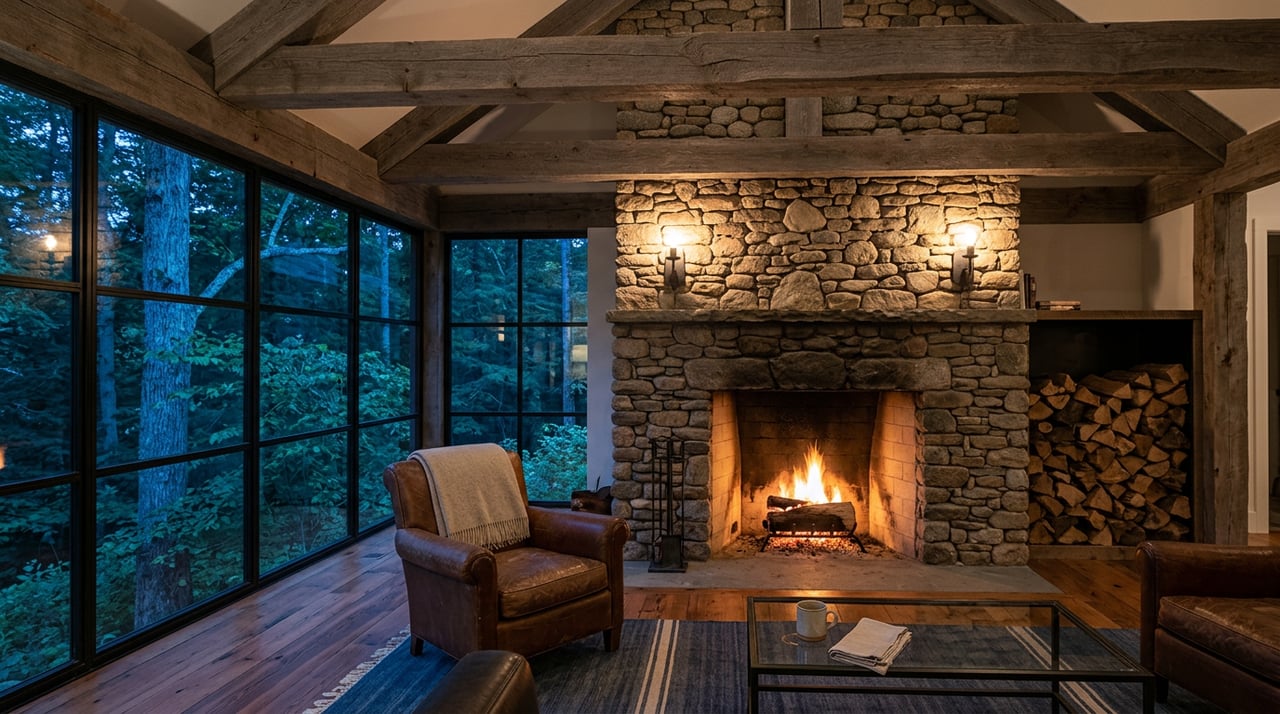
In Dawson County, Owning the Cabin Isn't the Hard Part of the STR Permit. Finding Your Agent Is.
An investor from Atlanta finds a three-bedroom cabin twenty minutes from Amicalola Falls, runs the numbers on a national short-term rental calculator, and pencils out a plan to manage the listing from a phone two counties away. The photos are good. The location sells itself, close to the Appalachian Trail approach, the falls themselves, and the North Georgia Premium Outlets. The math works on paper.
Then the permit application asks for something the spreadsheet never accounted for: the name and address of a designated agent who already lives in Dawson County or one of six specific neighboring counties. Not a property manager on a national roster. Not the owner, if the owner lives in Atlanta. A person, reachable in person, who resides within a defined radius of the house.
This is the detail that separates people who close on a Dawson County short-term rental from people who make an offer, get three weeks into permitting, and start calling around for a local contact they don't have.
Most short-term rental ordinances in North Georgia regulate the property: bedroom counts, parking, noise hours, septic capacity. Dawson County regulates the property too, but its ordinance spends just as much attention on a person. Under the county's short-term rental and bed and breakfast article, every permitted rental needs a designated agent who is a resident of Dawson County or an immediately adjacent county, and if that role is filled by a management company instead of an individual, the company itself has to be licensed to do business in Dawson County or one of those adjacent counties. Dawson County borders Forsyth, Lumpkin, Hall, Cherokee, Pickens, and Gilmer counties, so an agent based in Cumming, Dahlonega, Gainesville, or Jasper qualifies. An agent based in Atlanta, Marietta, or out of state does not.
The county's Board of Commissioners approved the most recent version of this language in September 2025, carrying forward wording that first appeared when the ordinance was adopted in December 2021. It has not softened with time. If anything, the current text tightens the same expectation: someone with a real, local address is accountable for what happens at the property, every single day it's occupied by guests.
That agent isn't a passive name on a form. If Dawson County receives a complaint about noise, parking, or conduct at the rental, the agent is the first call, and the ordinance gives them one hour to contact occupants and address the problem. County staff can also direct the agent to physically visit the property to confirm compliance. A national property management company with a call center in another state can't do that on a one-hour clock from three hundred miles away.
Zoom out and the residency requirement stops looking like bureaucratic friction and starts looking like the county's answer to a specific problem: absentee ownership without local accountability. A permit holder in another state can't respond to a 2 a.m. noise complaint at the pace the ordinance demands. A national management platform can dispatch a virtual assistant, but it can't put a person in a driveway within an hour.
Dawson County isn't unique in wanting a responsive local contact. What's unusual is that it wrote residency into the requirement itself, rather than just requiring 24/7 availability. That's the mechanism worth understanding before you write an offer, because it changes who can actually operate a compliant short-term rental here. A hands-off investor buying purely for appreciation and outsourcing everything to a national platform has to either relocate the compliance function to a local hire or accept that self-management isn't legally available to them the way it might be in a county with looser rules.
The agent requirement is the first friction point. The second is that Dawson County and the City of Dawsonville run separate permitting systems, and a property inside city limits needs both.
| Jurisdiction | What's required | Renewal timing |
|---|---|---|
| Dawson County (unincorporated) | STRBB permit through Community Development | Annual, tied to permit issue date |
| City of Dawsonville (in-town properties) | Separate city business license, in addition to the county permit | Renewals due November 20th annually, with late fees after |
If a cabin sits in unincorporated Dawson County, near Amicalola Falls or out toward the Chattahoochee National Forest boundary, only the county permit applies. If it's inside Dawsonville's city limits, the owner needs both the county STRBB permit and a separate city license, with its own $50 administrative fee plus a $225 full-year or $112.50 half-year license charge. Missing the city's November 20th renewal window doesn't just risk a late fee. It risks a gap in legal operating status for a listing that's already taking bookings.
Ask most first-time investors how many guests a cabin can sleep, and they'll count bedrooms and multiply by two. Dawson County's ordinance does the same math, capping occupancy at two people per bedroom with an overall six-bedroom maximum unless a property goes through special use approval by the Board of Commissioners. But the county doesn't take the owner's word for the bedroom count. Permitting requires documentation from the Dawson County Environmental Health Office specifying the number of bedrooms the property's septic system is rated to support.
That's the quiet ceiling on the investment. A five-bedroom farmhouse with a septic system permitted for three bedrooms doesn't get to advertise five-bedroom occupancy just because the floor plan has five rooms with doors. The environmental health record, not the listing photos, sets the real capacity, and it's worth pulling before you write an offer rather than after.
Layer the compliance requirements onto the revenue picture and the numbers stop being abstract. One 2026 short-term rental market estimate put median annual host revenue in Dawsonville around $23,947, with an average daily rate near $148 and roughly 56 percent occupancy across the year. Top-performing listings were pulling more than $39,888 annually. Those figures sit against a county where the minimum stay is two nights, meaning the one-night, weekend-arbitrage bookings some platforms optimize for aren't legally available here at all.
Run a six-bedroom cabin at the top end of that range and the agent requirement, the dual permitting, and the environmental health documentation start to look less like paperwork and more like the actual cost of entry. An owner who can't find or afford a qualifying local agent isn't losing a convenience. They're losing the ability to legally operate at all. Violations carry progressive penalties, and operating without a valid permit can bring a magistrate court citation and a fine up to $1,000, on top of whatever tax liability accrues under Georgia's hotel-motel tax framework, which already applies to short-term rental income statewide.
Can I serve as my own designated agent if I live outside Dawson County? Not under the current ordinance. The agent, whether that's the owner or someone the owner designates, has to reside in Dawson County or one of the six adjacent counties.
What happens if my agent moves away or steps down? The ordinance allows an owner to change the designated agent at any time, but the change has to be reported in writing to Dawson County Code Compliance before the new agent takes over.
Does the two-night minimum apply everywhere in the county, including inside Dawsonville? Yes. Renting a home or room for less than two nights is prohibited across Dawson County, and that applies whether the property sits in unincorporated areas or inside city limits.
Is this the same rule as Georgia's hotel-motel tax? No. The residency requirement governs who is accountable for the property day to day. Separately, short-term rental income in Georgia is also subject to state and local lodging tax collection, which platforms like Airbnb and Vrbo generally handle on the owner's behalf, though the underlying liability still rests with the owner if a platform fails to remit it.
If you're weighing a cabin near Amicalola Falls, a lot on the outskirts of Dawsonville, or a comparison between Dawson County and its neighbors up the mountain corridor, the permitting mechanics are the kind of detail that decides whether a purchase pencils out before you ever get to the fun part of furnishing it. Jacklyn Zuniga works across North Georgia's lake and mountain markets and can walk through what a specific parcel's zoning, septic documentation, and permit status actually look like before you write an offer. Let's Connect.
Stay up to date on the latest real estate trends.
With in-depth knowledge of the local market, skilled negotiation, and a client-first approach, Jacklyn works diligently to help buyers find the right home and sellers maximize the value of their property.
JACKLYN ZUNIGA
10900 Crabapple Rd Roswell, GA 30075