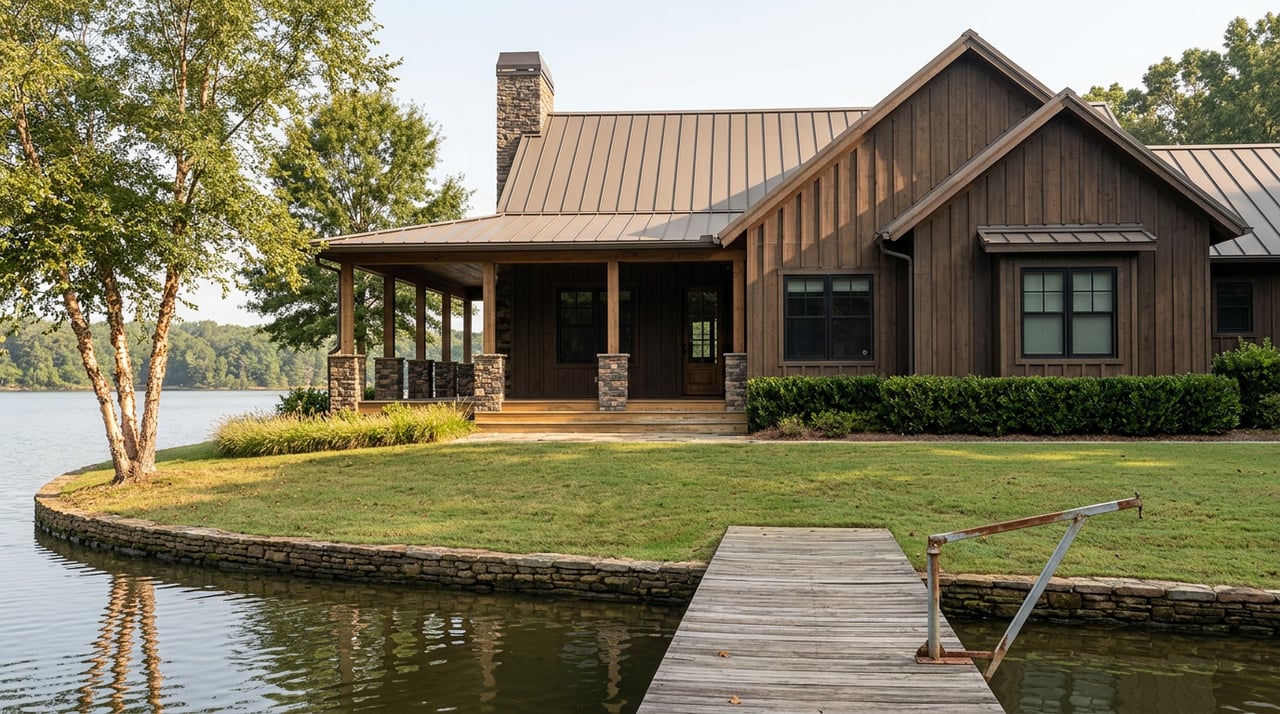
On Lake Lanier Near Buford, the House Isn't What You're Buying. The Dock Permit Is.
Two homes on the same cove near Buford Dam can list for the same price, carry the same square footage, and still be fundamentally different products. One comes with a private dock that a boat can tie up to next weekend. The other comes with a view of water you can look at but never legally touch with a fixed structure. The difference isn't finish level or lot size. It's a five-year federal license that most buyers don't think to ask about until they're already under contract.
That license is a Shoreline Use Permit issued by the U.S. Army Corps of Engineers, and it governs every private dock on Lake Lanier. The Corps capped the total number of these permits at 10,615 lake-wide under the 2004 Shoreline Management Plan and its accompanying Environmental Impact Statement. That cap has been fully allocated for years. No new private dock permits are being issued to properties that don't already have one, and there is no reliable waitlist that guarantees you'll ever get one.
Here's what that actually means if you're shopping the Buford side of the lake: the dock permit is the scarce asset. The house is the packaging it comes in.
The most common surprise for Lake Lanier buyers has nothing to do with price. It's this: a dock permit does not transfer automatically when a house sells. The permit is a personal federal license tied to the seller's name, and it expires the moment the deed changes hands. If you close on a Buford-area lake home on a Friday, the dock sitting in the water is, technically, unpermitted to you by Monday morning.
To fix that, the new owner has to file a formal Change of Owner application with the USACE Lanier Project Management Office at 1050 Buford Dam Road in Buford. A few things about that process catch buyers off guard:
Miss the filing window, fail the electrical inspection, or discover an unresolved violation from the prior owner, and the permit doesn't just get delayed. It can be pulled back into the federal system permanently, which means the dock you saw in the listing photos is no longer yours to use.
This is why due diligence on Lake Lanier has to happen before you write an offer, not during your inspection period. Once you're under contract, you have far less leverage to walk away over a permit problem than you do beforehand.
Here's the part that reframes how you should read a Lake Lanier listing. Because the total permit count is fixed and fully allocated, a dock permit doesn't behave like a normal home feature such as a finished basement or an updated kitchen. It behaves like a scarce license. Once a permit is revoked or abandoned for non-renewal, it goes back into a limited pool and does not stay attached to that parcel. The supply doesn't expand to meet demand. It just sits at 10,615, and pieces of it occasionally shuffle.
That scarcity shows up directly in price. Reporting on Lake Lanier sales pulled from Georgia MLS data around March 2026 put the median sale price for waterfront homes with a transferable Corps dock permit at approximately $1,250,000 across the ZIP codes that cover Buford, Cumming, Gainesville, and Flowery Branch shoreline (30518, 30519, 30506, 30542, and 30040). Lake-access homes in those same ZIP codes without a permitted private dock landed closer to $675,000 in that same window. Other market summaries from the same period describe the dock premium more conservatively, in the $100,000 to $400,000 range over a comparable non-dock lot. The exact figure moves depending on which comps you're looking at, but every version of the number lands in six figures, and that's the point. You are not paying a little more for a dock. You are paying for access to a fixed federal inventory that stopped growing years ago.
Buford's stretch of the lake carries an additional wrinkle worth knowing before you tour. The South Lake basin near Buford Dam holds the deepest navigable water on Lake Lanier, with a full pool elevation of 1,071 feet above mean sea level. That depth is what supports the larger double-slip and covered docks that command the biggest premiums. Georgia MLS data from March 2026 put median list pricing for permitted double-slip dock homes in the South Lake basin between $1.6 million and $3.5 million, depending on frontage and structure size. Move a few coves north into shallower water and the same square footage of house sits on a dock that may go dry during winter drawdown, which is a very different product even if the listing photo looks the same.
| Tier | What it actually includes | Typical price signal (Georgia MLS, March 2026 reporting) |
|---|---|---|
| True waterfront, permitted private dock | USACE Shoreline Use Permit in the seller's name, physical dock structure | Median around $1,250,000 across core Lake Lanier ZIP codes |
| Lake-access (no private dock) | HOA or community shoreline frontage, shared dock or ramp | Median around $675,000 in the same ZIP codes |
| Lake-view only | Sightline to the water, no Corps permit, no shoreline rights | Prices on visual sightline, which can disappear as trees mature |
One more variable worth understanding before you compare docks side by side: Lake Lanier's elevation moves on a managed annual cycle, not just rainfall. Full summer pool is 1,071 feet, the congressionally authorized level set when Buford Dam was completed in 1957, and the Corps targets that elevation by around June 1 for boating season. As of late July 2026, the lake sat at roughly 1,066.5 feet, about 4.5 feet below full pool, according to the USGS gauge at Buford Dam. In late fall and winter, the Corps intentionally draws the lake down further, typically to somewhere between 1,060 and 1,065 feet, to create flood storage capacity ahead of spring rain.
That seasonal swing is exactly why a photo taken in August and a walkthrough in January can show two different docks. A permit tells you what you're legally allowed to build. Water depth at that specific point in the cove tells you whether you can actually use it year round. Buford's deep-water advantage near the dam is one reason South Lake docks hold up better through drawdown than docks tucked into shallower northern coves, but it's still worth checking the cove's history before you assume a summer showing represents how the property behaves every month of the year.
There's a historical footnote here that's easy to miss. Back in 2009, the Corps reopened dock permit applications after a two-year pause, but only after the lake held at or above 1,064 feet for 30 consecutive days with a stable five-week forecast, per reporting from the Gainesville Times. Even then, only 174 permits remained, and they went to a lottery. That's the last meaningful influx of new permits the lake has seen. It's a useful reminder that the supply side of this market doesn't respond to demand the way a normal housing market does. It responds to Corps policy and lake conditions, full stop.
If you're comparing homes on the Buford side of Lake Lanier, treat the dock permit like its own line item in due diligence, separate from the house inspection:
None of this shows up on an automated online home valuation. Algorithms can price square footage. They can't price a federal license cap or a cove's depth at winter drawdown.
If you're weighing a Lake Lanier property near Buford and trying to figure out what you're actually paying for, that's exactly the kind of due diligence Jacklyn Zuniga walks buyers through before an offer goes in, not after. Let's Connect and talk through the specific dock, cove, and county details for the property you have in mind.
Stay up to date on the latest real estate trends.


With in-depth knowledge of the local market, skilled negotiation, and a client-first approach, Jacklyn works diligently to help buyers find the right home and sellers maximize the value of their property.
JACKLYN ZUNIGA
10900 Crabapple Rd Roswell, GA 30075